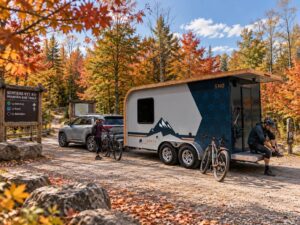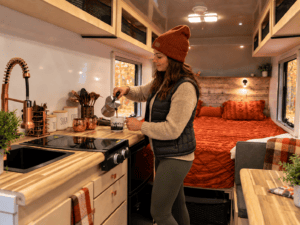



It’s one of the most searched questions among Canadian RV buyers who want to extend their season into winter: can you actually use a travel trailer when temperatures drop to -20°C? The answer is yes, but with an important qualifier. Not every trailer can do it safely or comfortably. Whether a trailer performs at -20°C depends almost entirely on how it was designed and built, not on how it’s marketed.
What Happens to a Standard Trailer at -20°C
A three-season trailer taken to -20°C will struggle in predictable ways. The pipes freeze first, typically within a few hours if they’re routed under the floor without heat protection. The heating system runs continuously but can’t keep up, because the walls lose heat faster than the furnace can replace it. Condensation forms on windows and walls as warm interior air meets the cold exterior surfaces. And the tanks, fresh water, grey water, black water, can crack if they’re not heated or insulated.
These aren’t rare failures. They’re the expected outcome of using a trailer outside its design range. The question isn’t whether it can survive one cold night with enough propane, it’s whether it can function normally, with water running and comfortable temperatures, through a week at -20°C.
What a Purpose-Built Winter Trailer Does Differently
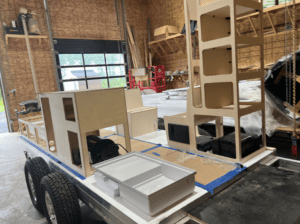
A trailer engineered for -20°C operation addresses each of these failure points at the design level. The wall insulation is thick enough, R-20 or higher throughout, to maintain a meaningful barrier between interior and exterior temperatures without the heating system running flat out. The plumbing sits inside the heated envelope or is protected by integrated heat trace wiring with thermostatic control. The tanks are insulated or actively heated. The underbelly is sealed against wind and road spray.
Our article on SNØ vs. a mainstream travel trailer shows exactly how these differences play out between a trailer built for winter and one adapted for it.
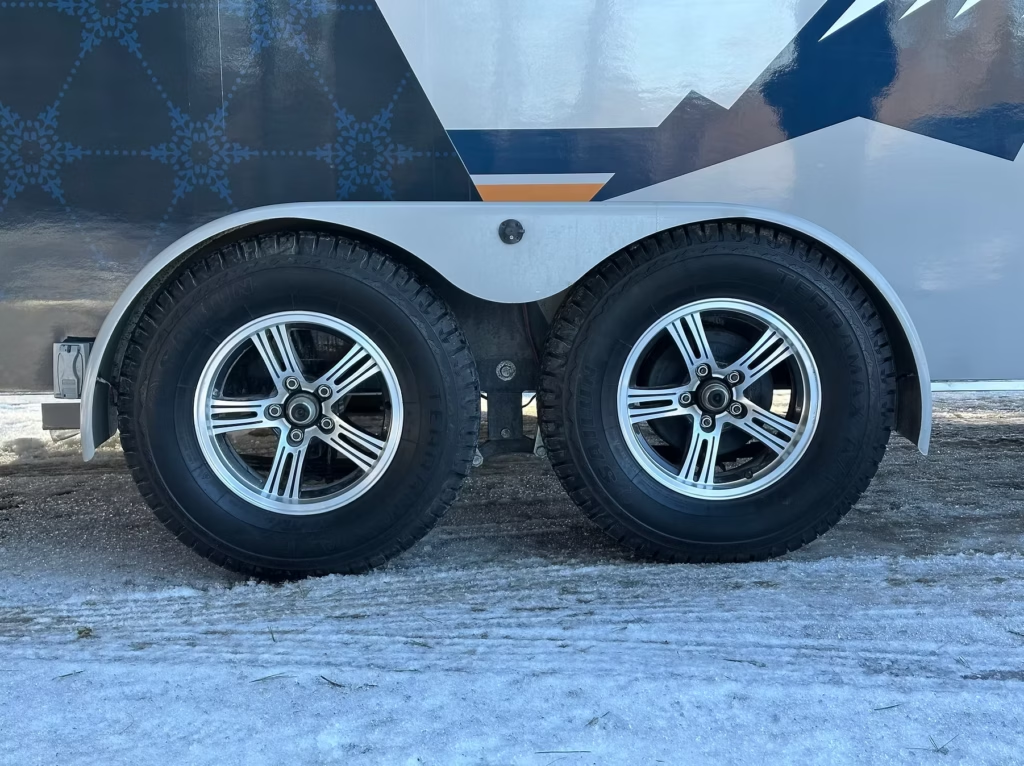
The Heating System: Propane vs Diesel at -20°C
The heating system is the most critical component at -20°C, and the type matters significantly. Propane furnaces have a known weakness at very low temperatures: propane struggles to vaporize efficiently below about -42°C at sea level, but cold tanks and long hose runs reduce effective pressure well before that point. At -20°C, a propane furnace typically still functions, but its efficiency drops, and it produces water vapour as a byproduct of combustion, which worsens condensation.
A diesel heater with a sealed combustion chamber draws air from outside and exhausts outside, adding no humidity to the interior air. It operates at consistent efficiency regardless of outdoor temperature and performs reliably through Canadian winter conditions. For sustained use at -20°C, diesel heating is the more reliable choice. Our post on the real criteria of a four-season trailer covers heating system differences in detail.
Condensation at -20°C: Why It Gets Worse
The colder the outdoor temperature, the greater the temperature differential between the warm interior and the cold exterior surfaces, and the more aggressively condensation forms. At -20°C, a poorly insulated wall creates a cold interior surface that can accumulate moisture from every breath, every meal cooked, and every shower taken. Over several days, this moisture damages insulation, promotes mold, and degrades structural components.
A well-insulated trailer with double-pane windows and thermally broken frames keeps interior surfaces warm enough that condensation is manageable rather than constant. Combined with a diesel heating system that adds no interior moisture and good ventilation habits, a properly designed trailer handles -20°C condensation far better than one retrofitted with extra insulation.
What the SNØ Is Rated For
The SNØ from Liberté Caravans was designed by a Canadian engineer who spent years working on radar sites in the Canadian Arctic. The design baseline is Canadian winter, not shoulder-season use with a winter package added. The SNØ delivers R-20 insulation throughout walls, floor and roof, a heating system designed for sustained cold operation, and freeze-protected plumbing. Under favourable conditions, it can maintain a comfortable interior temperature at sustained outdoor temperatures well below -20°C.
Explore the full specifications to understand how the SNØ is built for Canadian winter, or book a visit to see it in person and ask the team your specific questions.
What the Specifications Tell You That the Label Doesn’t
Yes, you can use a travel trailer at -20°C, if it was built to handle those conditions. A trailer with R-20 insulation, integrated freeze protection, and a diesel heating system can operate comfortably at -20°C and well beyond. A three-season trailer with a winter package probably cannot, at least not reliably, and not without risk of damage to the plumbing and structure.
The label on the door is not the answer. The specifications inside the walls are. Before camping at -20°C, verify the R-values, confirm how the plumbing is protected, and understand what temperature range the heating system was actually rated for. Our checklist on how to know if a travel trailer is truly four-season gives you the right questions to ask.