

Walk into any RV dealership in Canada and you’ll find travel trailers in a dozen configurations, teardrop trailers, toy haulers, fifth wheels, lightweight travel trailers, hybrid campers. Each has its advocates, and each has real tradeoffs. But when the question is which type performs best in Canadian winters, the answer isn’t about the floor plan or the axle configuration. It’s about how the trailer was engineered for cold.
Why Trailer Type Matters Less Than Construction
The most common mistake buyers make when searching for a winter trailer is filtering by type first, fifth wheel vs travel trailer, for example, before understanding what actually determines cold-weather performance. A fifth wheel with thin insulation and exposed plumbing will fail at -20°C just as surely as a lightweight travel trailer with the same shortcomings. The type of trailer determines the floor plan, the towing setup, and the living space. The construction determines whether it works in winter.
What matters most for Canadian winters is insulation R-value throughout walls, floor, and roof; the type and rating of the heating system; how the plumbing is protected from freezing; underbelly sealing; and window quality. These factors apply regardless of whether the trailer is a bumper-pull, a fifth wheel, or a hybrid. Our post on the real criteria of a four-season trailer covers each of these in detail.
Travel Trailers vs Fifth Wheels for Winter
Fifth wheels offer more living space and a more stable tow than bumper-pull travel trailers, which makes them appealing for extended winter use. The tradeoff is weight, fifth wheels are heavier, require a pickup truck with a fifth wheel hitch, and are harder to manoeuvre in snowy or icy conditions. For buyers who want a spacious winter base camp and have the tow vehicle for it, a well-insulated fifth wheel is a legitimate option.
Bumper-pull travel trailers are more versatile, they tow behind a wider range of vehicles, are easier to back into sites, and tend to have better weight-to-insulation ratios in the premium four-season segment. For most Canadian buyers who want a genuine winter trailer without the complexity of a fifth wheel setup, a well-built travel trailer is the more practical choice. The key word in both cases is “well-built”, a travel trailer with R-20 insulation outperforms a fifth wheel with R-7.
Lightweight and Teardrop Trailers in Winter
Lightweight and teardrop trailers have a devoted following for their towability and simplicity. In summer, their advantages are clear: nearly any vehicle can tow them, they’re easy to set up, and they fit in smaller campsites. In winter, their compact construction becomes a limitation. Small trailers have limited wall thickness, which caps the insulation R-value. Heating systems in lightweight trailers are often sized for mild conditions, not sustained cold. And with less thermal mass, temperature swings are more pronounced.
Some manufacturers offer lightweight trailers with winter packages, but the physics of thin walls limits how much cold-weather performance can be achieved. For serious Canadian winter use, a week at -20°C in the Laurentians, for example, a lightweight trailer is generally not the right tool.
What “Four-Season” Actually Means Across Trailer Types
The “four-season” label appears on trailers across every category, lightweight teardrops, mid-size travel trailers, large fifth wheels. As noted in our post on how to know if a travel trailer is truly four-season, the term isn’t regulated and manufacturers apply it freely. A four-season label on a lightweight trailer means something very different from a four-season label on a trailer purpose-built for Arctic conditions.
The only reliable way to evaluate a “four-season” claim across any trailer type is to look at the specifications: R-values on each surface, plumbing protection method, heating system type and rated operating temperature, and underbelly construction. These numbers tell you more than the category or the label.
The SNØ: A Travel Trailer Built Around Canadian Winter
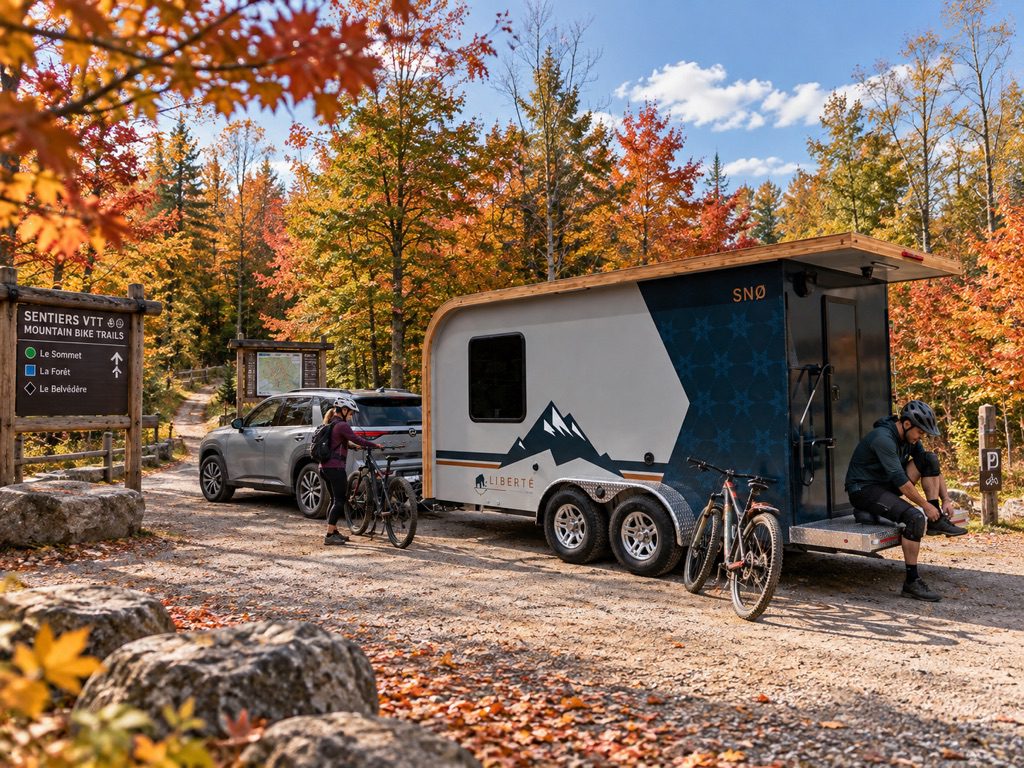
The SNØ from Liberté Caravans is a bumper-pull travel trailer built around one design principle: Canadian winter use as the baseline, not the exception. R-20 insulation throughout walls, floor, and roof; a heating system designed for sustained below-zero operation; freeze-protected plumbing; and a five-year warranty from a Canadian manufacturer who builds in Ontario.
For buyers who want a genuine four-season travel trailer, not a three-season model with winter add-ons, the SNØ represents what a purpose-built winter trailer looks like in practice. Explore the full specifications and pricing, or book a visit to see it in person.