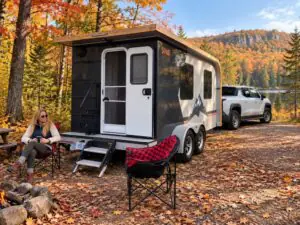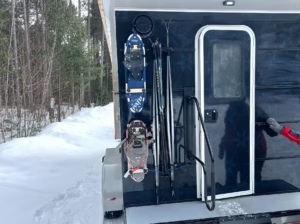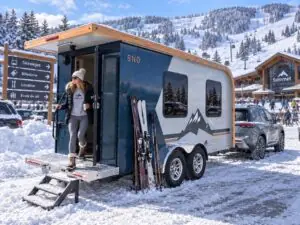


The difference between a trailer that handles Canadian winters and one that merely claims to is largely invisible at a dealership. The floor plans look similar, the interiors feel comfortable, and the “four-season” badge appears on models across a wide price range. The real differences live inside the walls, under the floor, and in the specifications most sellers don’t volunteer. Here are the eight features worth verifying before you commit.
1. Insulation R-Value; on Every Surface
R-value measures resistance to heat flow, and it matters on all three major surfaces: walls, floor, and roof. A standard three-season trailer typically runs R-7 to R-11 in the walls. For sustained use below -15 °C in Canada, a minimum of R-20 throughout is a reasonable baseline. Ask for the specific R-value of each surface separately, not a single advertised number that may apply only to the best-performing section. Our post on the real criteria of a four-season trailer covers what these numbers mean in practice.
2. Heating System Type and Efficiency
Propane furnaces are the most common option, but they have real limitations in sustained cold: efficiency drops at very low temperatures, and open-combustion units add moisture to the interior air worsening condensation. A diesel heater with a sealed combustion chamber operates efficiently regardless of outdoor temperature and adds no interior humidity. Ask specifically what type of heating system is installed and whether it was tested at temperatures below -20 °C.
3. Pipe and Plumbing Freeze Protection
This is where many “four-season” trailers fall short. Ask to see the fresh-water tank, pump, and lines — are they inside the heated envelope, or do they rely on electric heat trace wiring exposed under the floor? Integrated heat trace wiring with a thermostat that activates automatically is the reliable solution. A trailer without it will eventually freeze if temperatures drop far enough, regardless of what the label says.
4. Underbelly Sealing and Protection
A sealed belly pan protects pipes and tanks from road spray, snow, and salt while keeping cold air from circulating under the floor. Ask about its construction: is it a single continuous seal, or are there seams and fastener points where moisture can enter? Ask what, if anything, remains exposed below it. A well-sealed underbelly is not the same as a freeze-proof one the distinction matters.
5. Window and Door Sealing
Windows are among the most significant sources of heat loss in a trailer. Double-pane windows with thermally broken frames reduce heat transfer at these vulnerable points. Equally important are the seals around every opening windows, doors, vents, and utility penetrations. Air infiltration carries both heat and moisture through the envelope, and poorly sealed openings undermine even excellent wall insulation.
6. Off-Grid Power Capability
Canadian winter destinations aren’t always fully serviced campgrounds. Ask about battery capacity, solar compatibility, and whether the electrical system is rated for cold-weather battery performance. Lithium batteries with integrated thermal management charge reliably below 0 °C; standard lead-acid batteries lose significant capacity in the cold. If off-grid winter camping is part of your plan, the power system matters as much as the insulation.
7. Warranty Coverage and Winter Use
Not all warranties cover winter use explicitly and some exclude water damage unless it can be proven to result from a manufacturing defect rather than wear over time. Before signing, ask whether winter operation is covered, where warranty service is performed, and how long repairs typically take. A five-year warranty from a manufacturer who builds specifically for Canadian winters like the SNØ from Liberté Caravans provides a different level of assurance than a one-year warranty from a brand that treats winter as an edge case.
8. The Manufacturer’s Track Record in Canadian Winters
Ask the manufacturer or dealer for references from customers who actively use the trailer in Canadian winter conditions, not just fall camping. Ask whether the trailer has been tested at sustained temperatures below -20 °C. A manufacturer confident in their cold-weather engineering will welcome these questions. One who deflects them or offers only general assurances is telling you something important about the product’s actual design intent.
If you’d like to see how these eight features come together in a trailer built for year-round Canadian use, visit the SNØ specifications or book a visit to inspect the trailer in person.