

A four-season label does not tell you how long a trailer can remain comfortable and functional below freezing. Some models extend a warm-weather design with tank heaters and extra insulation; others are built around winter use from the start. Bring this checklist to the showroom and ask the seller to show you each feature on the actual trailer.
1. FIND THE WATER SYSTEMS
Ask to see the fresh-water tank, pump, lines, traps and drains. Are they above a sealed, insulated floor, within the heated envelope, or beneath the floor where protection depends on electric heat? In the SNØ, the water systems sit above the insulated floor. Even so, any water-filled trailer can eventually freeze during a prolonged loss of cabin heat.
2. TEST THE DRAIN AND WINTERIZATION SETUP
Locate the low-point drains and ask for a demonstration. A pre-connected, easy-to-access drain arrangement makes it simpler to empty the system before storage or an extended shutdown. Confirm which tanks, lines and fixtures actually drain, whether any water remains trapped, and what additional winterization steps the manufacturer requires.
3. TRACE THE INSULATED ENVELOPE
Look beyond an advertised R-value. Ask how the walls, roof and floor connect; how windows, doors and penetrations are sealed; and where metal creates thermal bridges. The SNØ uses a 3½-inch wall assembly as part of its structural and thermal envelope. Wall thickness alone does not prove performance, but a continuous, well-sealed enclosure helps maintain even temperatures and reduce cold surfaces where condensation forms.
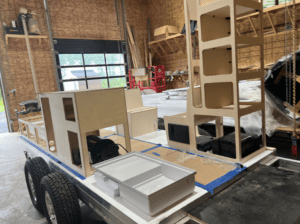
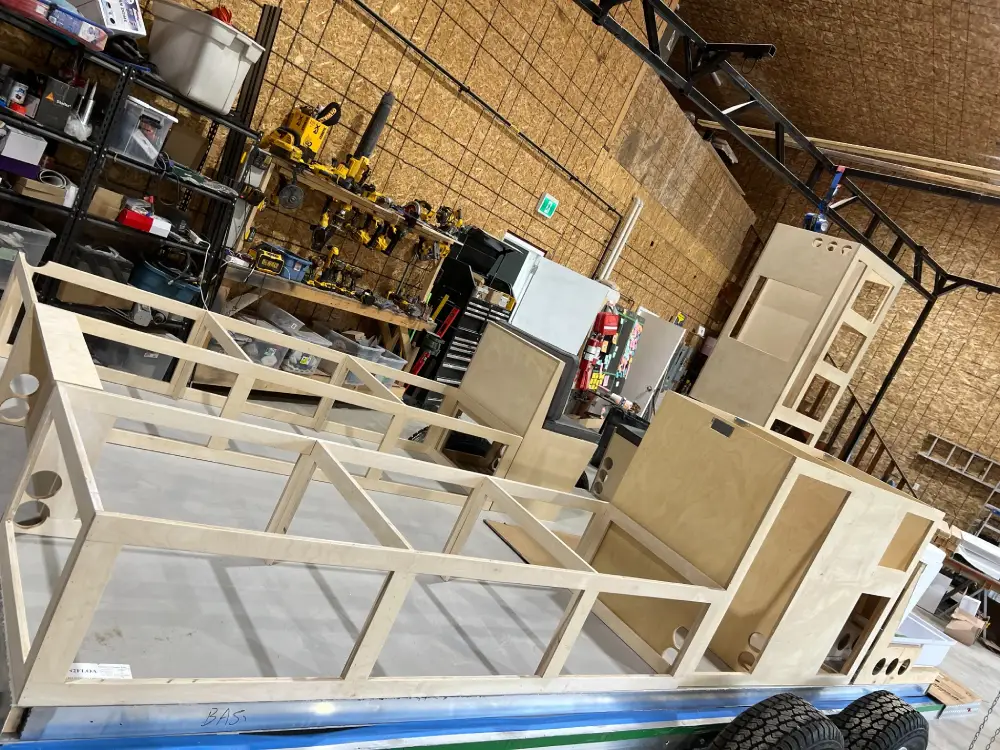
The SNØ structure during construction: ask to see what lies behind the finished walls.
4. IDENTIFY BOTH HEAT SOURCES
Ask whether the trailer can heat with propane and with electricity, and how each mode works. Electric heat may require shore power or a suitably sized generator. A propane furnace may still need 12 V power for its controls and fan. Have the seller explain the switchover, battery demand and what continues to operate during an outage.
5. INSPECT THE UNDERSIDE
A sealed belly pan should protect the underside from road spray, snow and salt while leaving a sensible way to inspect or service components. Check its seams, fasteners and openings, rather than assuming that an enclosed underbelly makes plumbing freeze-proof. Ask what, if anything, remains exposed below it.
6. PLAN FOR OFF-GRID POWER
If you rely on a generator, confirm there is a practical storage location with adequate capacity, secure mounting and access. Ask where it can be operated safely outdoors: never run a generator inside a trailer or storage compartment. Check the trailer’s electrical input and the generator capacity needed for the equipment you plan to use.
7. CHECK THE FRAME, AXLES AND TIRES
An aluminum frame avoids the red rust associated with steel, but aluminum and its fasteners can still corrode in road-salt conditions. Ask about material, dissimilar-metal isolation and cleaning. Tandem axles can add load capacity and stability, but verify the actual ratings. For winter travel, check that the tires have appropriate winter traction, load rating and size; a winter tread pattern alone is not a complete specification.
8. ASK FOR A REAL WINTER DEMONSTRATION
Have the builder explain heating and propane consumption at a stated outdoor temperature, indoor set point and wind condition. Under favourable conditions, the SNØ trailer can heat its cabin in sub-zero weather for up to 20 days on one 20 lb propane tank; actual duration depends on use and weather. Ask how ventilation controls humidity without wasting unnecessary heat.
A truly winter-capable trailer should have answers you can inspect, operate and understand. Follow the route of water, heat and air through the whole trailer. Those details tell you more than the seasonal name on its brochure.
If this checklist raises questions you hadn’t thought to ask before, that’s exactly the point. For a deeper look at the technical standards that separate a genuine winter trailer from one that simply carries the label, read our post on the real criteria of a four-season trailer, insulation, heating and condensation. And if you want to understand the most common ways buyers get caught off guard before their first winter trip, common mistakes when buying a four-season trailer covers what to watch for at every step of the process.